

Acknowledging concerns about overindebtedness in Cambodia’s microfinance sector, FMO is supporting a mediation pilot. Building trust and ensuring that dispute resolution works for the people who need it most, is the main challenge.
Cambodia’s financial sector has expanded rapidly over the past few decades. This growth has opened opportunities for households and small businesses, but it has also brought challenges. Behind every loan - whether taken to buy land, open a shop or cover a family emergency - there is a story. In recent years, many of these stories have become more complex, shaped by concerns around overindebtedness, disputes between borrowers and lenders and a growing public call for fair and accessible solutions.
FMO recognizes these concerns. A few of the institutions active in Cambodia’s microfinance sector are longstanding partners and when challenges arise in sectors we support, we have a responsibility to engage. That is why, since 2023, FMO has initiated and taken part in the UN-facilitated multistakeholder dialogue that has brought together regulators, lenders, civil society, development partners and international institutions; organizations that do not regularly sit at the same table. Enhancing borrower representation within this group remains an area FMO continues to explore.
One practical result of the dialogue has been the establishment of the Working Group on Debt Counselling and Mediation, which helps stakeholders understand each other’s perspectives and fosters collaboration on addressing the urgent issues related to borrower vulnerability and over-indebtedness. An important part of addressing overindebtedness is ensuring that borrowers have somewhere to turn when conflicts arise. The banks themselves have complaints mechanisms, strengthened over the past few years. But particularly in rural areas and among indigenous communities and women borrowers, there is still a need for a more easily accessible-, reliable- and non-institutional system that can provide support in liaising with lending parties, formal and informal.
This is why FMO is supporting the project “Enabled Access to Alternative Justice to Redress Indebtedness”, implemented in partnership with the National Authority for Alternative Dispute Resolution (NADR) and Oxfam Cambodia. The project – a pilot implemented in the provinces of Kracheh, Stung Treng, Mondulkiri, Ratanakiri - aims to expand access to fair, professional, and trusted mediation for finance-related disputes, providing an alternative to court processes. Local authorities, such as commune chiefs, are also an important first point of contact when borrowers face repayment difficulties. Through initiatives like NADR, these local authorities now have additional avenues to refer cases for mediation. The NADR’s approach is focused on neutrality and procedural fairness, but awareness about the existence of these mediation possibilities remains a challenge. Civil society organizations – playing a crucial role in bringing overindebtness to the forefront and ensuring that the experiences of borrowers are heard – also emphasize the importance of grievance mechanisms that are neutral, accessible and trusted by all parties, particularly in a context where low levels of trust continue to affect dispute resolution mechanisms more broadly These realities guide our support to the NADR: strengthening independence, expanding outreach and ensuring that mediation mechanisms work for the people who need them most.
Taken together, these realities show that addressing overindebtedness in Cambodia requires long-term, patient cooperation. It involves strengthening the practices of financial institutions, reinforcing borrower protections and ensuring that dispute-resolution mechanisms reach underserved communities, whether it is through the NADR or other valuable initiatives like IFC’s Financial Consumer Center. As FMO’s Chief Risk Officer Franca Vossen noted at the launch of NADR’s recent project, building trust takes time, and strengthening institutions requires persistent, collective effort. FMO will continue working alongside Cambodian authorities, civil society and our DFI peers. By acknowledging the challenges and supporting practical solutions, we aim to contribute to a financial system that is fairer, more transparent, and better equipped to protect borrowers across the country.
----------------------------------------------------------------------------------------------------------
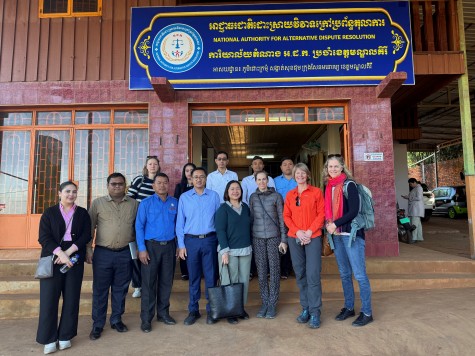
During FMO’s recent trip to Cambodia in February 2026, we visited Mondulkiri province, where we met a woman who was willing to share her experience with debt and her current financial situation. She is an Indigenous farmer who grows avocados, durian, and other fruits. Her husband previously worked in construction, and together they support their children.
A few years ago, she took out two loans - one for USD 80,000 in 2023 and another for USD 25,000 in 2024 - to purchase land in her province. One plot was intended for building a new family home, while the others were bought with the expectation of selling them later at a higher price. For many years, Cambodia’s land market had been booming, and she hoped to benefit from rising land values. With income from the farm and her husband’s construction work, the family was initially able to meet the monthly repayments of around USD 2,000.
Two years after taking the first loan, however, their situation changed. The Cambodian economy began to slow down, and her husband lost his job in construction. At the same time, one of their children moved to Phnom Penh to attend university, increasing the family’s monthly expenses by roughly USD 1,000 for housing, living costs, and tuition fees. As a result, she increasingly struggled to meet her repayment obligations. Collection officers visited her home regularly and pressured her to sell her land at a discount, adding to the stress the family was already experiencing. The woman said she is willing to sell the land to repay the loan, but she is asking for more time to find a buyer who will pay a realistic price.
One of the financial institutions offered to restructure her loan by extending the repayment period. However, even with this adjustment, she told FMO, the proposed payments remained beyond what she could realistically afford. Seeking guidance, she approached the commune chief, who is now working with her to explore possible solutions for the family’s situation.
This case illustrates the complexity of overindebtedness in practice. It is rarely the result of a single decision, but rather of a combination of economic shocks, income volatility, rising household expenses, and limited bargaining power. Many families across Cambodia face similar circumstances and are actively looking for solutions that allow them to resolve their debt in a fair and dignified way, without losing their livelihoods or homes. In such cases, professional and trusted mediation can play an important role by creating space for dialogue between borrowers and financial institutions, helping both sides to explore realistic and sustainable outcomes.
FMO’s due diligence of financial institutions has strengthened over the years, especially with regards to the Client protection risk, assessing whether microfinance institutions (MFIs) are taking adequate measures to prevent client harm, including over-indebtedness, responsible pricing, fair treatment of clients, and transparency.
Since 2022 every MFI transaction undergoes a Client Protection (CP) risk categorization. If a transaction is categorized as high CP risk, an external CP assessment is required along with an action plan. We also endorse the Client Protection Pathway (SPTF-Cerise) and where gaps exist, this is also included in the action plan. We support clients to meet the requirements, providing Technical Assistance when needed.
Decisions are based on the evidence from the CP assessment (by an external for high risk, internally for medium risk) and the action plan.
Closely linked to this is the fine-tuning of our CP risk scoring methodology to lower the threshold for high-risk classification, enabling early triggers resulting in heightened due diligence and monitoring.
Cambodia is listed in FMO's CP very high-risk country list and will automatically be assessed as a High CP risk category regardless of any institution's score.
In 2024, FMO hired an in-house CP Specialist to further strengthen client protection assessment and monitoring.